Grandma Gertie always said there's not a savory dish that can't be made tastier by just a touch of tarragon.

Tsunami and Me

Tsunami and Me
too big to escape now....

Monday, December 23, 2013

Tzimtzum...For Everything There is a Season

This was the first of the season series...my story is "Tombstone Territory"
 A little over a year ago I wrote of how my energy ebbed as the days shortened in "Hibernating Through the Holidays." http://atouchoftarragon.blogspot.com/2012/11/hibernating-through-holidays.html. It looks as if I'm doing it again! This time, I'm not letting any guilt feelings seep through to spoil my period of tzimtzum!

I'm not certain when I began to believe that rest and recuperation, even in winter, amounted to just plain shirking. I suspect it may have started  in my preadolescence. Grandma Gertie's favorite maxim seemed to be the one about idol hands and the devil's mischief. Somehow I managed to internalize that noxious idea...that busyness equated with goodness, rest with evil. Sloth...a deadly sin, she'd remind me...sloth, sloth, sloth!

Last week a psychoanalyst friend in Los Angeles, also a widow, emailed me that she had been pressured by adult children to visit with them and other relatives over the holidays...and all she really wanted to be was alone with her animals, the dogs she calls her co-therapists.

I wrote back that I shared her preference...that I wanted to enjoy some solitude, as well. Even though there's always plenty to do, projects to complete, stories to write, friends to correspond with and visit, what I really craved for a holiday treat was a period of rest and renewal.

This is the present I've given myself this season. And it's been a rewarding week...Fred Astaire movies, murder mysteries and afternoon naps. I've not been totally idle, oh, no. One afternoon I devoted hours to cleaning out my email inbox! That's a task that doesn't require much effort, only a lot of time.

My very wise friend in Los Angeles also is a Sephardic Jew who attends the Sinai Temple. A few days after we shared our mutual embrace of solitude for the holidays, she sent me a piece written by Rabbi David Wolpe, for his column, Off the Pulpit. To my astonishment, I'd never before heard of the concept of tzimtzum...but it's absolutely what I'm experiencing during this cold winter season.

I've pasted it below...for those who still feel guilty because their own frowning Grandma Gertie act-alike shook a finger whenever they longed to sneak away with a Bobbsey Twin adventure instead of sweeping their bedroom...here's an antidote to the poison of guilt!

Addition by Contraction 

The mystics speak of tzimtzum, withdrawal or contraction. God, who fills all, contracts into God’s self to allow space for the world to be created. Tzimtzum is a concept in theological physics, teaching what it means to limit oneself to enable creation.

It is also a lesson in human psychology. We too create space within ourselves, within our lives. The lesson of tzimtzum is that withdrawal precedes overflow; the cistern bursts forth in a fountain. Moses withdraws for 40 days up the mountain and comes down to teach. Rabbi Akiba leaves for years to study and returns to become the Gadol Hador, the great one of his generation.

There are moments in life to expand, and stretch beyond our usual capacities. But we learn from this powerful mystical concept how important it is now and again to contract, to make smaller, to withdraw. In a world that fills our minds and our time, the ability is increasingly important. God created a space to make the world. We make a space inside ourselves to let the world in. Then we can open to give more of ourselves to our world.
Rabbi David Wolpe is spiritual leader of Sinai Temple in Los Angeles. Follow him on Twitter: @RabbiWolpe.

The entire four season series by Tending Your Inner Garden  is still available as a special:

http://tendingyourinnergarden.com/

Friday, December 13, 2013

Who Chooses Your Shoes?

At last "The Choosing Shoes Blues" sees print!


Yesterday the mail carrier delivered a box containing Donna Clark Goodrich's latest book for Hidden Brook Press, Grandfather, Father and Me: Memories, Poetry and Good Food. New anthologies devoted to moms and grandmoms appear each spring as Mother's Day nears. Since I first began to write the stories of my life seven years ago, I've not noted many call outs for male progenitors. Perhaps editors and publishers figure dads don't bother to read sentimental recollections. Maybe they figure there's little market for these books.

I'm happy that this Canadian publisher entrusted Donna to compile this collection. This is the 85th anthology that includes one of my stories...and I think I had the most fun writing this one. I'd written "The Choosing Shoes Blues" several years ago for another anthology that failed to materialize. Sometimes when I'm writing a story I feel myself transported back in time, where I can feel, smell, taste how different life was in past decades.

With this story I revisited 1951 Los Angeles. I once again roamed the aisles of the Sears store at Slauson and Vermont, and wiped down the lunch counter at Owl Drug Store where I held my first official job. Sure, I'd earned money as a baby sitter, but now I got a real pay envelope, with Social Security deductions, rather than a handful of quarters.Once again as I wrote I could feel my toes turn to ice as water seeped into the flimsy shoes I'd treated myself to on that first payday...the first I'd ever worn that I'd chosen for myself.

I'm so enjoying this book...I notice a recipe for chili that I might try tonight, as well as one for fudge that's tempting indeed. This book would make a great gift for Gramps for Father's Day...I think older men would be tickled at the post-Depression-era recipes for not-quite-ham salad and a Sunday mac and cheese dish that calls for lard. Younger male forbears will grin as they read of how their offspring remember how they rested on the back porch or visited the old fishing hole. You can buy Grandfather, Father and Me here:

http://www.hiddenbrookpress.com/HBP.html


The Choosing Shoes Blues

My big sister, Patti, and I rarely agreed on anything in our adolescence, but when it came time to shop for back-to-school shoes, we sang the same tune. And it was the blues.

Back in l951, the high school set considered black patent leather Mary Janes or Capezio-type instep strap shells as good as it gets, so of course we longed to step into them ourselves. But Daddy believed in function, not fashion, plus he moonlighted as a shoe salesman at a department store where he enjoyed an employee discount.

Even though World War II was behind us, and the economy was good, these were still conservative days, and Daddy, who well remembered the Depression years, worked two jobs to provide for a wife and three kids, and to send a few dollars monthly to his aging mother.

For weeks Patti and I had been showing Mama the ads in the daily Los Angeles Herald-Express, and pleading our case. But though she’d been sympathetic about our entreaties for straight skirts, pullover sweaters and Peter Pan collars, when it came to shoes, she agreed with Daddy. Shoes were costly, and a single pair each would have to last the entire school year.

We pouted, we sulked, we sighed, but all to no avail. One inevitable September Saturday morning we piled into the back seat of the family Chevy, and Daddy drove to the Sears Roebuck that anchored the shopping strip at Slauson and Vermont.

“Meet me in the shoe department in about half an hour,” he said, pulling into the rear parking lot.

Patti and I exchanged gleeful glances. While Daddy punched in at the time clock and got his cash register set up for the day, we could browse Lerner’s, Mode O’Day and some of the other dress shops that lined Vermont Avenue. And we could peer into the windows of Buster Brown, Kinney’s and Bakers, and admire the latest trends in footwear and accessories.

That half hour sped by, and we finally had to drag ourselves back to Sears. In those days, shoe salesmen still used a shoe-fitting x-ray unit called a fluoroscope to determine proper size. Patti stepped up first to have Daddy measure her feet.

Patti’s feet had grown into a size seven, so she grinned and gave me a quick wink. She now wore the same size shoe as Cousin Patricia, and would benefit when Aunt Betty, Daddy’s sister, came over with her annual armload of hand-me-downs.

Aunt Betty lived in a large house in Altadena with a swimming pool. When her daughter, Patricia, a few years our senior, purchased new school clothes each fall, we got the cast offs. We looked forward to trying on the discards, and some of the sweaters and jackets were very welcome. Mama would discreetly set aside most of the dresses and blouses for the Goodwill, though, since she considered them far too mature or worldly for us. But Patricia’s shoes were to die for…ballet flats, moccasins, even some Cuban heels.

But I still measured my same old size six, so this meant that whatever shoes I…or rather, Daddy…chose would be the ones I’d trudge to school in every day all year long, unless I could double or triple my babysitting business, which paid a quarter an hour.
I’d edged over to the shelf that held the rounded-toe Mary Jane look-alikes, and brandished a pair under Daddy’s nose. “These look really nice,” I cooed.

“Nonsense. They’d fall apart in a week.” Daddy knew shoes, so there was no debating.
My heart sank when he plucked up a pair of black objects that I could only describe as indescribable. They looked like squat, stocky, clunky Mary Janes…but without the strap, dumpy, stubby loafers…but without the slot for the penny. But to Daddy they simply looked…sturdy. I knew I was doomed.

“These are shoes made to last!” Daddy declared.

 “Why, they look just fine,” Patti said, feigning delight. I grimaced but nodded.
The first few weeks of school I skulked about, hoping nobody would notice my footwear. I caught a few girls glancing downwards and hiding grins. I pretended not to notice, but determined to find a way to get some other shoes. Patti, of course, left the house each day light-footed in a variety of secondhand but fashionable shoes.

So I landed a soda fountain job at Owl Drug Store, right across from Sears. I’d be working Mondays and Fridays, 5 to 9 pm, and all day Saturday, earning the munificent minimum wage of sixty cents an hour. I’d fry up hamburgers and toss together root beer floats, and at the end of Saturday afternoon, Lucky, the fountain boss, would hand me a paycheck.

The first thing I bought, of course, was a pair of Capezio-style strapped shells. In about six weeks I’d worn holes in the soles. When I took them to the shoe repair shop I learned that they were too fragile to resole, so I had to make do with liners I cut from an old cardboard box. They lasted another week until I had to slog home from the drugstore one night in a downpour and the sodden straps fell off.

Reluctantly, I dragged out Daddy’s nondescript clunkers and wore them for the rest of the year. I could be fashionable…or I could be warm and dry. Why did those two alternatives have to be so incompatible? Once I even caught Lucky smirking at my feet when he thought I wasn’t looking.

Fortunately the following autumn black and white saddles came into vogue, so when we took our annual trek to the Sears shoe department I eyed those stalwart oxfords with genuine appreciation and even expressed gratitude for Daddy’s discount. Now I could save my paycheck for brand new angora sweaters and matching angora socks, and leave the latest batch of Cousin Patricia’s leftovers, mostly out-of-style tweed sheathes, to Patti, along with the outdated size seven Mary Janes.

Somehow that early experience killed my lust for stylish but flimsy shoes. Over the years I’ve tended towards loafers, sports shoes and pumps. And recently I’ve come to realize that the Hush Puppies I favor today look suspiciously like descendents of those stouthearted shoes I once blushed to be seen in.

That, of course, was in those distant days before I came to share Daddy’s practical philosophy of good value for money…and learned that utility should trump fashion.


Wednesday, November 27, 2013

Please Pass the Celery


I don't know about you...maybe your favorite Thanksgiving dish is pumpkin pie, chestnut stuffing, green bean casserole even a cranberry and orange jello mold. Mine? It was always Auntie Dorothy's celery! This story was first published in 2010 in Thanksgiving Tales: True Stories of the Holiday in America.


Spellbound by Swanky Swigs


By Terri Elders


This past November I laid in a good supply of cheese spreads…for stuffing celery for Thanksgiving dinner, of course. My grocer still stocks those little Kraft jars with the savory olive pimiento and roka blue flavors I’ve always loved, but I regret that now they’re sold in plain little glass jars, not the glamorous red tulip or blue cornflower juice glasses of my girlhood. Even so, I could hardly wait to get the jars home and once again sample my favorite canapĂ©.

Of course, if they were still around, Grandma and Mama probably would laugh at my nostalgia, just as they laughed at those glasses in their l940s heyday, and at Auntie Dorothy who always toted them to our holiday feast. Even as a girl I realized that when it came to holiday dinners, my female forbears were culinary elitists with rigid ideas about appropriate bills of fare. Cheese-stuffed celery, in their view, was just plain cheesy. And Grandma and Mama could be downright catty.

Looking back, it seems as if every year as soon as we set aside the candy corn and jack-o'-lanterns, Grandma and Mama would huddle in the kitchen to conduct their annual Thanksgiving dinner debate.

One year when I was twelve, the awkward age, too old for toys, too young for boys, I joined the women in the kitchen, volunteering to peel potatoes or shell peas. I had seen Grandma pull her writing tablet and yellow pencil out of her purse, and knew that the confab was about to begin. The two would bicker and banter on the venue and the menu…and then get down to the real family gossip as they discussed who would bring what. I didn’t want to miss a word.

“We’ll do it again at my house, since I have the larger dining room,” Grandma began.

“But our house is so much more accessible,” Mama countered.

“I have a kitchen table for the children,” Grandma parried.

I smiled to myself. Grandma always won this argument. Never in my memory had the family gathered elsewhere, but Mama always felt obligated to put in her pitch. I’d overheard her tell Daddy she didn’t know how she’d accommodate everybody if Grandma ever actually gave in.

“I’ve been thinking about the menu. Maybe a ham would be nice this year,” Mama ventured, winking at me. I knew she loved to tease Grandma.

“Oh, Mama, that sounds wonderful, and with pineapple garnishes!” I chimed in, conspiratorially.

“For heaven’s sake, it’s Thanksgiving. We’ll have turkey just as we always do,” Grandma folded her arms and stared at the two us as if we’d both lost our senses.

 Mama nodded. “OK, I’ll bake the pumpkin pies.”

“And I’ll make lemon meringue, since you know that the boys don’t like pumpkin.”

 Grandma tapped her pencil on the table. “Should we ask Joe and Julia if they’d do the sweet potatoes and mashed potatoes? Joe always eats three times more potatoes than everybody else put together, so maybe if they’re in charge they’ll bring enough to go around.”

Mama and I grinned. Burly Uncle Joe could be counted on to ensure there’d be no leftover spuds. When he’d ask for his fourth helping, Aunt Julia would pass him the bowl with a big smile, proud of her trencherman spouse.

“And what about Teddy?” Mama loved her bachelor stepbrother, but knew he couldn’t cook worth a whit.

“Let’s ask him to bring some wine,” Grandma said, gnawing on her pencil. “He makes plenty of dough, so maybe we should suggest champagne.”

Mama brightened. I don’t think I’d ever seen champagne at a family feast, and I don’t recall Mama and Daddy having any even on New Year’s Eve.

“Poor Opal can bring the green bean casserole,” Grandma continued. I perked up, waiting for more information. It was true that Auntie Opal always looked pale and tired, but I wasn’t certain why.

“Well, the way Jim drinks, Opal has to look after the house, the jewelry shop and raise those kids practically on her own. It’ll be a wonder if she finds the energy to open a can of onion rings,” Mama observed.

Grandma stared at her tablet and scribbled a few words. “I’ll do the turkey, stuffing and gravy, and you can make some rolls. I guess Dorothy will bring the celery,” Grandma said, looking up. “And she’ll think she’s done something special when she brings that dreadful processed cheese in those dinky little glasses.”

Mama snickered, but I held my breath. I loved helping Auntie Dorothy stuff the celery, and adored the elegant flowered glasses she said were mine.

Mama sighed. “Just because she and Roy never had children is no reason for her not to learn to cook. She should be making decent suppers for her husband instead of expecting him to live on baked beans and bacon sandwiches.”

I set down my potato peeler and waited expectantly. I couldn’t imagine Daddy’s reaction if Mama put such a meal before him, but it sure sounded tasty to me.

“Roy has the patience of a saint,” Grandma said, shaking her head. “Imagine that woman off to the church every day to play the piano for choir practice, when she should be cleaning that little apartment.” I’d been to those practices with Auntie Dorothy. The choir even let me sing along, even though I knew I wasn’t quite on pitch.

On Thanksgiving we gathered at Grandma’s. Uncle Jim greeted us jovially, smelling of equal parts Old Spice and Old Crow. Uncle Joe huffed and puffed up the steps, a tub of potatoes tucked under each arm. When Auntie Dorothy arrived with her big brown bag, I hurried to her side.

“Can I help you get your celery ready?”

“Of course, and I’ve got another cheese glass for you, too.” I gaped, spellbound, as she pulled the latest acquisition to my collection out of the bag…a rare black tulip.

Today I open my kitchen cabinet and gaze at the miniature tumblers that I’ve treasured for over half a century: tulips, forget-me-nots, lilies of the valley, bachelor buttons, and my favorite, a light blue cornflower with emerald leaves.

When I checked recently on e-Bay I was astonished to learn that these days collectors call these humble glasses swanky swigs, and they’re highly regarded for their ornate decals. They now sell for what Grandma would have called a pretty penny. Why, one set of four blue tulips is listed for twenty bucks, and forget-me-nots go for at least eight dollars each.

I pull down the black tulip and hold it up to the sunlight. Not only can I recall the snap and crunch of Auntie Dorothy’s celery filled with pineapple cheese, I remember how Mama poured half an inch of Teddy’s bubbly into this very same tumbler, and I, feeling swanky indeed, had taken my first swig of champagne.

For supper tonight maybe I’ll fry up some bacon and open a can of beans, fill a few stalks of celery with roka blue. I’ll check the pantry for champagne so I can toast to the entire family that provided such memorable Thanksgiving dinners, including, especially, Auntie Dorothy.

(Here is the link for the story on Google, and you can also read it on Amazon with the "look inside" feature.)

http://books.google.com/books?id=Nm2fLuO6v0QC&pg=PA7&lpg=PA7&dq=spellbound+by+swanky+swigs&source=bl&ots=lPVN5W_Dam&sig=jkGA14AlMfxGeuC-UiiqzJhCC2o&hl=en&sa=X&ei=2z6WUsiBKpHZoATupILYCA&ved=0CDgQ6AEwAQ#v=onepage&q=spellbound%20by%20swanky%20swigs&f=false

Tuesday, November 26, 2013

Gardens For All Seasons


My handyman came around last week and hauled tarps full of fallen leaves to the back pasture. Because it's been cold and damp, the leaves didn't make for the kind of autumn bonfire that I remember Grandma Gertie built on the back of our property when we lived in Scotts Mills back in the '40s. Instead, of sizzling flames leaping from the pile, the leaves simply smoked and smoldered for hours, finally fizzling out. The pile leveled down somewhat, but it's still fringed by some forlorn taupe-hued reminders of just a few weeks ago, when the crisp fall air sent my spirits plummeting.

Skiing, skating and sledding friends here have a hard time understanding this. They welcome the first snowfall, and begin to plan trips to their cabins. But I dread winter's onset...it's too cold and icy in this far northeastern corner of Washington State for a California-born sun-kissed miss. Nonetheless, I intend to gain comfort through these cold days by rereading the Tending Your Inner Garden series all over again, beginning with the first volume, Winter.

Deb Engle and Diane Glass have conducted Tending Your Inner Garden workshops for several years now, using the seasons as a model for change. Whether you're a master gardener or have only sowed an occasional handful of poppy seeds, these books will inspire you to view nature in a spiritual way.

Right now, the books are offered together as a holiday special at a 25% discount...just $49.95 for the complete set, regularly regularly $67.80. These gift sets can be ordered here:
http://tendingyourinnergarden.com/bookstore/

A few years ago I read a call out for stories for this series, and welcomed a chance to publish material of mine that was more essay than story. I'm pleased and honored to be featured in all four of the books, which are described by Deb and Diane below.


Winter: Women’s Stories, Poems and Inspiration for the Season of Rest and Renewal, with my "Tombstone Territory"
We’re thrilled to introduce the first of four Tending Your Inner Garden® books featuring writing from women around the world on themes inspired by the seasons of the year.
The book brings together the work of established authors with first-time writers, all of whom have compelling stories to tell. This first volume focuses on a season of the year that can be challenging because of its stillness and dormancy. Yet winter offers valuable lessons and a resource in short supply in the world—time for reflection, rest and quiet.
Submissions came from all around the world. We selected the work of 31 women whose poetry, essays and stories spoke to both profound and common life experiences—endings and beginnings, renewal, creativity and stillness. As we share these stories and poems, we create and deepen a sacred circle of support on the spiritual path.
Suggestions for journaling and reflection are offered to readers as a guide to appreciating the gifts of this season.
 
Spring: Women’s Inspiration for the Season of Hope and New Beginnings, with my "Maybe Tuesday Will Be My Good News Day"
The second of our four Tending Your Inner Garden® books features the universal and inspiring themes of spring: renewal, possibilities, hope, new beginnings and emergence.
Spring is a time when nature begins its endless cycle once again, giving each of us an opportunity to refresh and renew. The essays and poems in this volume speak to those themes with grace, humor and a sense of trust that no matter what life brings, spring will always present new possibilities.
Suggestions for journaling and reflection are offered as a guide for appreciating the gifts of this season.

Summer: Women's Writings for the season of Beauty and Resilience, with my "When He Looked Like James Dean"
The third of our four Tending Your Inner Garden® books features the universal and inspiring themes of summer: resilience, beauty, storms, mindfulness and joy.
Summer blesses us with both gifts and challenges: Riotous color and parched grassland. Thunderous storms and blissful sunny days. Hot, buggy evenings and cool early mornings. Kaleidoscope-like butterflies and ravenous locusts. Most of us welcome summer if for no other reason than it surprises us year after year.
Summer: Women’s Writings for the Season of Beauty and Resilience will delight you with the adventures it offers and the memories it evokes.
“Now is the season to call back your heart,” Celeste Snowber tells us in “Bodypsalm for Playing.” This volume will help you do so by evoking feelings associated with the season. Then take pen and paper and use the journaling questions at the end of the book to capture your own memories of summer.
  
Fall: Women's Stories and Poems for the Season of Wisdom and Gratitude, with my "Autumn Aubade"
After a season of rapid growth and blossoming—so characteristic of summer—fall invites you to sit back, reflect, savor, celebrate and surrender. In your metaphorical autumn, you allow life lessons to integrate back into the soil of your Inner Garden. You recall the joys and sorrows of the year that has passed, acknowledging both milestones and setbacks. And then you let go, knowing that life events are transitory and the cycle of the seasons begins again.
This transition brings both pleasure and sadness. It’s not easy to witness such beauty, grace and ripening without holding on. Yet when you do, you leave with the treasure of rich memories.
The women in this final volume in our Tending Your Inner Garden® series have harvested the fruits of an ever-changing life. They offer their remembrances, gratitude, realizations and guidance. Read their essays and poems, and then turn to the journaling questions at the back of the book to feast on the bounty of your own life.

Friday, November 22, 2013

Aldous Huxley's Appointment With Eternity on 11/22/63

Laura Archera Huxley


 Though I never met Aldous Huxley, his dystopian novel, Brave New World, had a profound effect on me when I was a member of the Manual Arts Science Fiction and Fantasy Club back in the early '50s. I still recall discussing the influence Huxley and his work had on one of his students, George Orwell (then Eric Blair) and whether novels such as Huxley's and Orwell's1984 could actually be considered science fiction at all.

Both Huxley and C.S. Lewis, who also created a world of his own in Narnia, died fifty years ago today...on such a heavy news day that most newspapers and television broadcasts didn't even  mention their passing.

In 1979 I met Huxley's widow, Laura Archera Huxley, when she visited MacLaren Hall, the Los Angeles County temporary pre-placement residence facility for abused and neglected children. I was the psychiatric social worker for the nursery and Laura had a special interest in infants and toddlers. Laura, in the International Year of the Child, appeared at countless seminars, conferences and universities to promote her projects: Prelude to Conception, Reverence for Life, Project Caressing, Children: Our Ultimate Investment and others. All were devoted to the premise that one baby touches a thousand lives and should be considered an endowment to the world's future.

I'd known of her years earlier, from reading her landmark book, You are Not the Target, one of the earliest of the self-help genre that proliferated through the next couple of decades. The subtitle of the book had intrigued me: Recipes for Living and Loving. One particular recipe I even tried, Dance Naked to Music. I shared the story of how I had secluded myself in my bedroom and played Oscar Levant's recording of George Gershwin's Rhapsody in Blue, divested myself of all my clothes and had shimmied about the room for nearly an hour. She'd smiled. She loved a bit of quirkiness, and recounted how she and Huxley had married in 1956 at a drive-in chapel in Yuma, Arizona.

I wrote about Laura and her projects for a Long Beach arts magazine, Uncle Jam, for its October 1979 issue. I described her thusly:
"If anyone is an embodiment of the 'young person over sixty' that Laura Huxley writes and talks about, it is Laura herself. She moves with the agility and grace of a teenage ballerina, speaks with the lilting enthusiasm of a child on Christmas morning, and hugs with the artistry and vigor of at top contender, would that there were a world-class competition in this event. She is Ariel incarnate, but earthy, as well."

She visited the MacLaren nursery several times and in turn two or three times I visited her home beneath the Hollywood sign. She wrote about her life with Huxley in This Timeless Moment and never hesitated to introduce her husband's views into our conversations. Once as we sat in her living room, sipping coffee, she told me about how she coped on November 22, 1963. Huxley was dying of cancer and the house was filled with close friends. A roar had gone up in her living room, and when she investigated she learned the president had been assassinated in Dallas. She pleaded that they visitors turn down the sound on the television and returned to her husband's side. She knew he was struggling to let go as his life ebbed. Unable to speak, he scribbled a request for LSD, so she gave him an injection. He began to relax as she held his hand and whispered words of love, urging him to move toward the light.

Among my treasures is a copy of Huxley's The Doors of Perception that Laura inscribed..."For Terry, from her admirer, affectionately, Laura." I also have a framed copy of a letter she sent praising the Uncle Jam article.

Since Kennedy's murder, I've always awakened on November 22 with a vague sense of unease...and then I remember why. The events of that dismal weekend so long ago replay in my mind as my day progresses. Others tell me they have the same sense of dread when they first recognize what day it is. Since I met Laura, though, I also remember how Aldous Huxley, called by many the foremost literary mind of the 20th century, eased toward his own brave new world, soothed and comforted by his wife.

For more reflections on both Huxley and C. S. Lewis:

http://www.theguardian.com/books/2013/nov/22/other-heroes-cs-lewis-aldous-huxley


http://www.theguardian.com/commentisfree/2013/nov/22/aldous-huxley-prophet-dystopia-cs-lewis

Aldous Huxley

Tuesday, November 19, 2013

To Give Peace a Chance


Kennedy Greets Inaugural PCVs in Rose Garden, 1961

“Action speaks louder than words, but not nearly as often.” --–Mark Twain

“Great Uncle Loring once shook hands with Abraham Lincoln,” my grandmother used to say, her prideful face aglow. “This was right after the Emancipation Proclamation. And everybody in our family has voted Republican ever since.”

When I was growing up I doubted that I would be the first in the family to stray from the faithful elephant parade. But at 2 a.m. on October 14, 1960, Senator John F. Kennedy addressed a crowd of shivering students on the steps of the Union at the University of Michigan. Just weeks before the national elections, he challenged them to devote two years to work in developing countries with Peace Corps.

When I heard the radio broadcast later that morning, I pictured myself boarding a plane for Tanganyika or Paraguay where I would teach toddlers to read. I envied those students who might have this chance to serve.

But it could not happen, I told myself. First, it was unlikely Kennedy would get elected. Nobody in my family or my husband’s thought that the young man from Massachusetts could divert enough votes from frontrunner Nixon.

Second, I was married, had a toddler, and was working towards a bachelor’s degree. When I mentioned Kennedy’s proposal to my husband, he just laughed.

“There’s children right here in Southern California who need to learn to read. You don’t have to go overseas to make your dreams come true,” he pointed out.

Until Election Day, I still hadn’t made up my mind. But inside the booth I thought that even if I couldn’t have that chance to serve, I should advocate for those who could. So I voted for Kennedy, knowing that my husband would tease me later about our votes canceling each other.

A few months later, I privately thrilled to JFK’s inaugural address. I had always scoffed at the notion that I belonged to a so-called Silent Generation. Now Kennedy insisted that the torch had been passed to a new generation of Americans, one that would be vocal and active. I vowed to be part of that generation.

Of course my husband had been right about people needing help at home as well as overseas. So I got a teaching credential and settled in as a high school English and journalism teacher right in Long Beach, CA.

The day Kennedy was shot, I turned on the classroom radio and we listened as the horrific story unfolded. I sent students in relays to the nurse’s office for boxes of Kleenex. I thought about Great-Great-Great-Uncle Loring, and wished I’d had the opportunity to shake Kennedy’s hand. Now it would never be.

A few years later, after riots rocked our inner cities, I abandoned teaching to become a caseworker to help rebuild South Central Los Angeles. My parents had a tough time understanding this. They remembered the depression years, and seemed to think I was working in a soup kitchen. No matter how much I tried to explain about Lyndon Johnson’s War on Poverty and the Equal Opportunity Act, they insisted upon telling friends, “Terri’s working for The Dole.”  I knew they pictured me wrapped in a big white apron, ladling out soup. Eventually I returned to graduate school and earned an MSW at UCLA.

Then finally, at 50, divorced, my son grown, I joined the Peace Corps. Friends raised eyebrows and issues:  “Aren’t you a bit, how shall I put this, uhhhh, old?”  “Do you think you’re up for mosquitoes and pit latrines?”   “You know, don’t you, that older people have a lot of trouble learning new languages?”

I developed some pat rejoinders. Peace Corps reassured me that a number of seniors join. With my skills, I would most likely live in towns or cities, not a mud hut. I could relearn my high school Spanish and college French, if need be.

I joined, rejoined and then extended. After a decade overseas, I returned to the States and became a health programming and training specialist at Peace Corps headquarters in Washington DC. In this capacity I helped strengthen efforts of Volunteers in dozens of countries to address malnutrition, HIV/AIDS, and the infectious diseases that lead to high infant mortality rates.

On January 29, 2002, Sargent Shriver, the brother-in-law of JFK, and founding director of the Peace Corps, gave a speech at the Directors Forum at Peace Corps Headquarters to a packed audience of about 200 staffers. Frail, in the early stages of Alzheimer’s, Shriver nonetheless read in a strong voice from his notes and emphasized that peace is more than just the absence of war. He affirmed that peace “is living together based on what we have in common. Our differences matter less than our kinship.”  I took notes.

After his speech, he shook hands with dozens of us, nodding as we told him where we had served as Volunteers. “I’m honored to shake your hand,” I told him. “I owe my whole life to you and to President Kennedy.”

“I’m honored to shake yours,” he said.

After I retired in 2004 I continued to speak at schools and before service groups during Peace Corps week each March. When Hurricane Katrina and Rita combined to decimate the Gulf States in 2005, I joined Peace Corps’ short term Crisis Corps and spent a month in Beaumont TX with FEMA, helping those who had lost everything but their lives.

A few years ago I was keynote speaker at the Oregon School Counselor’s Association Conference. For a PowerPoint presentation I spent a week sorting through photographs in my faded old paisley duffel bag.

Once again I saw myself leaning against a coconut palm in the front yard of my house on Regent Street in Belize City, perching behind my counterpart on her motorcycle in San Juan de la Maguana, Dominican Republic, and painting murals on the Youth Center fence with teens in Mont Fleuri, Seychelles.

What an incredible adventure for me…all because I heard an inspired and inspirational campaign speech by JFK over fifty years ago.

Saturday, November 9, 2013

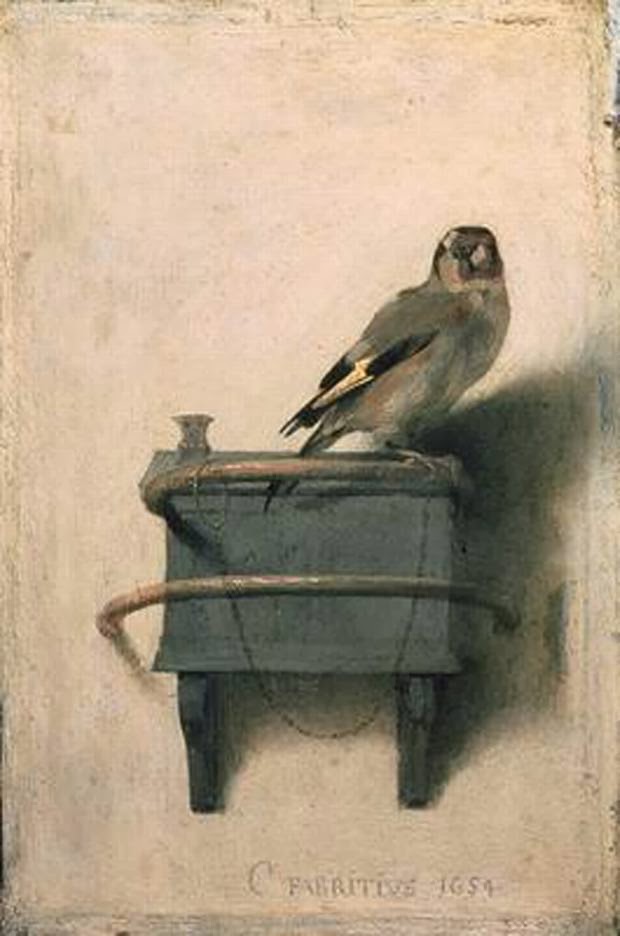
The Goldfinch: This Bird Can Fly!

The next book I'll pick up from my bedside stack won't tumble into my hands and stick to them like glue, but Donna Tartt's The Goldfinch certainly did. It's been a late night week for me...and friends have been asking where I've been. I've been lost with Theo Decker, Tartt's protagonist, in New York City, Las Vegas and Amsterdam. I've been coming of age once again, just as I did with Holden Caulfield and David Copperfield. I've been lost in a literary masterpiece...a novel as complex as Carel Fabritius' painting "The Goldfish" itself.

Amazon just picked this novel as "the book of the year." For me it's the book of a decade. I understand that Tartt took ten years to research and write this book...and it shows on every page. Her prose is as gorgeously crafted as it was with her two previous novels, The Secret History and The Little Friend. This time around, however, age and experience are on her side. As Tartt grows older, she shows more understanding of the human condition...right now I hope I live long enough to read her next work.

Amazon picks Donna Tartt's 'The Goldfinch' as book of the year

By Patricia Reaney

NEW YORK Thu Nov 7, 2013 3:17pm EST


(Reuters) - Author Donna Tartt's "The Goldfinch," a novel about a 14-year-old boy surviving in Manhattan after the death of his mother, topped Amazon.com Inc's list of 100 best books of 2013.
The list, released on Thursday, is compiled by editors at the online retailer. The top choices include fiction and non-fiction works, a collection of short stories, a young adult novel and an account of being held captive in Somalia.
"The Goldfinch" is Tartt's first book since "The Little Friend" in 2002, which followed her 1992 debut novel "The Secret History."
"Our top choice, 'The Goldfinch,' is an emotionally trenchant masterpiece and was hands down our team's favorite book of the year," said Sara Nelson, editorial director of books and Kindle at Amazon.


After reading and rereading the last few pages last night, I'm back to my regular life, tending to the mundane yet still engrossing everyday tasks that make up my routine. I'm accompanied though by a new cast of characters...a 20th century Artful Dodger in Boris, an updated and healthier Little Nell in Pippa, another heartbreaking Estella in Kitsey. Theo will remain with me always...I can't forget him and his love for Carel Fabritius' artistic pun of a painting. Since it weighs in at over 780 pages, some complain that this heavy book contains too many words, claiming it should have been edited to a third of its size, caviling about the lengthy descriptions and inner dialogues. That's like telling Beethoven to take out some of the notes of his symphonies! It's in its details that its beauty emerges. For me this hefty tome is worth its weight in gold. Everything about this novel is golden, beginning with the glimmer on the wing of the brave bird it celebrates.

Now I want to see the painting in person...and it's in New York City right now at the Frick, until January 19. I've not been to New York in a long time, but seeing this exhibition would be worth the effort.

 Vermeer, Rembrandt, and Hals: Masterpieces of Dutch Painting from the Mauritshuis - See more at: http://www.frick.org//exhibitions/mauritshuis#sthash.rNeCl47E.dpuf


Vermeer, Rembrandt, and Hals: Masterpieces of Dutch Painting from the Mauritshuis

October 22, 2013 to January 19, 2014
The Frick Collection is pleased to announce that it is the final American venue of a global tour of paintings from the Royal Picture Gallery Mauritshuis in The Hague, the Netherlands. While the prestigious Dutch museum undergoes an extensive two-year renovation, it is lending masterpieces that have not traveled in nearly thirty years. - See more at: http://www.frick.org/exhibitions/current#sthash.k9OKCI6o.dpuf

Vermeer, Rembrandt, and Hals: Masterpieces of Dutch Painting from the Mauritshuis

October 22, 2013 to January 19, 2014
The Frick Collection is pleased to announce that it is the final American venue of a global tour of paintings from the Royal Picture Gallery Mauritshuis in The Hague, the Netherlands. While the prestigious Dutch museum undergoes an extensive two-year renovation, it is lending masterpieces that have not traveled in nearly thirty years. - See more at: http://www.frick.org/exhibitions/current#sthash.k9OKCI6o.dpuf

Vermeer, Rembrandt, and Hals: Masterpieces of Dutch Painting from the Mauritshuis

October 22, 2013 to January 19, 2014
The Frick Collection is pleased to announce that it is the final American venue of a global tour of paintings from the Royal Picture Gallery Mauritshuis in The Hague, the Netherlands. While the prestigious Dutch museum undergoes an extensive two-year renovation, it is lending masterpieces that have not traveled in nearly thirty years. - See more at: http://www.frick.org/exhibitions/current#sthash.k9OKCI6o.dpuf

Vermeer, Rembrandt, and Hals: Masterpieces of Dutch Painting from the Mauritshuis

October 22, 2013 to January 19, 2014
The Frick Collection is pleased to announce that it is the final American venue of a global tour of paintings from the Royal Picture Gallery Mauritshuis in The Hague, the Netherlands. While the prestigious Dutch museum undergoes an extensive two-year renovation, it is lending masterpieces that have not traveled in nearly thirty years. - See more at: http://www.frick.org/exhibitions/current#sthash.k9OKCI6o.dpuf

Vermeer, Rembrandt, and Hals: Masterpieces of Dutch Painting from the Mauritshuis

October 22, 2013 to January 19, 2014
The Frick Collection is pleased to announce that it is the final American venue of a global tour of paintings from the Royal Picture Gallery Mauritshuis in The Hague, the Netherlands. While the prestigious Dutch museum undergoes an extensive two-year renovation, it is lending masterpieces that have not traveled in nearly thirty years. - See more at: http://www.frick.org/exhibitions/current#sthash.k9OKCI6o.dpuf

Vermeer, Rembrandt, and Hals: Masterpieces of Dutch Painting from the Mauritshuis

October 22, 2013 to January 19, 2014
- See more at: http://www.frick.org/exhibitions/current#sthash.k9OKCI6o.dpuf
For more on Fabritius and this painting,  here's an engrossing commentary from 2006:

http://www.independent.co.uk/arts-entertainment/art/great-works/fabritius-carel-the-goldfinch-1654-744406.html